A Small-Space Guide to Styling a Christmas Table
A small dining area can still feel festive without a crowded table. Use a restrained palette, layered height and practical place settings to create a Christmas table that looks considered and leaves room to eat.
Our guides prioritise practical, original advice. Product links may be affiliate links, but they should only appear when they add something useful.
Styling a Christmas table in a small dining space is less about adding more decoration and more about choosing each element carefully. A compact table has limited surface area, while nearby walls, chairs and lighting can quickly make the room feel busy. The most successful schemes keep the centre low, repeat a small number of colours and make sure every decorative detail earns its place.
Start with the way the table will actually be used. If guests need room for serving dishes, drinks or shared plates, avoid filling the middle with a large arrangement. A simple runner, a few touches of foliage and well-chosen tableware can create a festive setting without getting in the way.
Begin with the table’s shape and everyday layout
Before choosing decorations, clear the table and look at the space around it. A round or square table usually benefits from one central arrangement, while a narrow rectangular table is often better suited to a linear runner or a series of small pieces. Keep the visual weight in proportion to the tabletop: a large, spreading display will make a small table look even tighter.
Think about where chairs need to move and whether the table is also used for homework, working or everyday meals. A removable arrangement is useful in a multifunctional room. Place decorative pieces on a tray or shallow board so they can be lifted away in one movement when the table needs to be cleared.
It also helps to decide whether the table needs to accommodate serving dishes. If food will be placed in the centre, leave a clear strip through the middle rather than styling right up to the edges. Where space is especially limited, serve from a nearby sideboard, kitchen island or trolley and keep the table setting deliberately light.
Choose a restrained Christmas colour palette
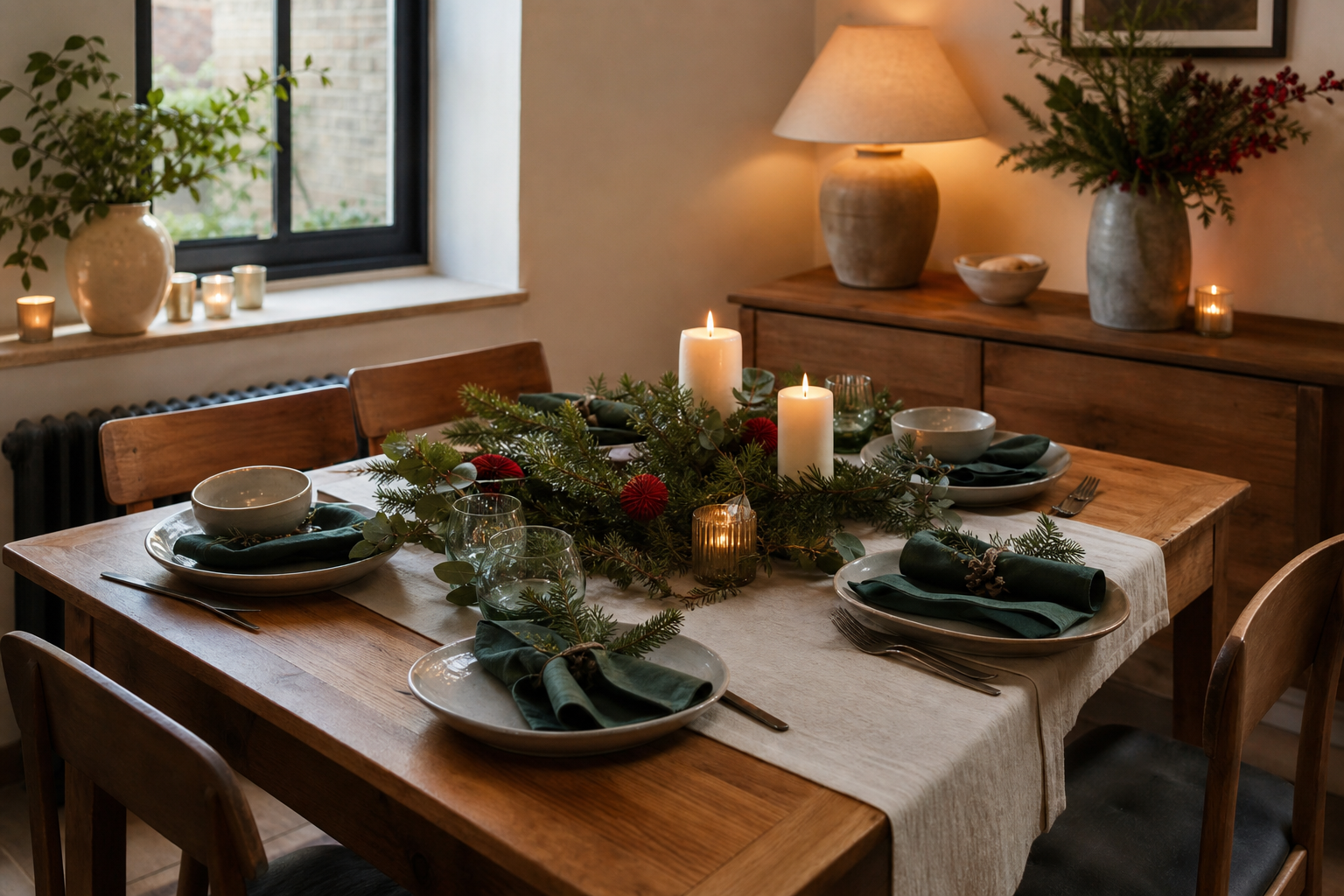
A compact room tends to look calmer when the table setting uses two or three main tones. Traditional red and green can work well, but they do not need to appear in equal amounts. Try warm white linen with deep green foliage and a small amount of red in napkins or ribbon. Alternatively, combine natural wood, soft ivory and muted metallics for a quieter look.
Use the room’s existing finishes as a guide. Timber furniture pairs naturally with foliage, cream ceramics and warm candlelight. A painted table can take contrast, such as dark green glassware or berry-coloured textiles, but too many competing shades may make the setting appear fragmented.
Repeating one accent colour across several small details gives the table a more intentional finish. For example, a single shade could appear in the napkins, place cards and a few baubles in the centre. Repetition is more effective in a small space than collecting unrelated festive objects.
Build the centre with low, moveable details
Height is useful for creating atmosphere, but tall centrepieces can block conversation and make a small dining area feel enclosed. Keep the main decoration low enough for people to see across the table. A narrow length of evergreen foliage, a few branches in a low vessel or a line of small jars can provide shape without taking over.
Instead of one bulky arrangement, group several modest pieces. A shallow bowl of baubles, a pair of short candlesticks and a few sprigs of foliage can feel layered while leaving gaps for plates and serving dishes. Vary the size slightly, but keep the materials connected so the arrangement does not become cluttered.
Use a tray or runner to give the centre a clear boundary. This makes separate objects read as one arrangement and makes the whole display easier to remove. A fabric runner can soften the table, while a bare timber surface may look better with just a few grouped objects and individual placemats.
Fresh foliage can bring colour and scent, but it should be kept away from flames and checked regularly if it begins to dry. Faux stems are practical for a display that needs to stay in place throughout the season. Whichever option you choose, trim or arrange it so that it does not brush against plates, sleeves or glasses.
Make place settings work harder
In a small dining space, the place setting can provide much of the festive detail without taking up extra central space. Begin with only what each guest needs: a plate, cutlery, a napkin and a glass. Add more pieces only if they will be used. This keeps the table visually open and reduces the chance of elbows catching decorations or glassware.
Fold napkins simply and place them on the plate or beside the cutlery. A sprig of rosemary, eucalyptus or other suitable foliage can add a seasonal touch, while a narrow ribbon or small paper name tag gives each place a personal finish. Avoid bulky napkin rings or large ornaments that compete with the crockery.
Choose tableware that supports the overall palette rather than introducing another theme. Plain white plates give colourful textiles room to stand out, while stoneware in a soft neutral shade can add warmth. If the table is already visually strong, simple glassware and uncomplicated cutlery will help balance it.
For very tight settings, use slim placemats or a small charger-style layer rather than both a large placemat and a decorative plate. Keep the edges of each place setting aligned so the table feels orderly. Small adjustments to spacing often make a compact table more comfortable than removing one more decorative object.
Use lighting to create warmth without crowding the table
Christmas table lighting should add a gentle glow rather than create another obstacle. Battery-operated lights can be tucked along a runner or into a glass vessel, keeping cables away from plates and chair legs. Use them sparingly; a few points of light are usually more effective than a bright strand spread across every surface.
Candles are another easy way to create atmosphere, but choose shapes and holders that suit the table’s scale. Short candles in stable holders work well where sightlines are limited. If using taper candles, keep them in secure holders and position them where they will not be knocked by sleeves, serving spoons or passing dishes.
Do not rely on the table alone for light. A nearby lamp, wall light or softly lit sideboard can make the whole dining corner feel more inviting and reduce the need to fill the table with candles. Warm-toned light generally works well with greenery, timber and festive textiles.
Add festive detail around the table instead
When the tabletop is full, move some of the seasonal decoration into the surrounding space. A wreath on a nearby wall, a small arrangement on a sideboard or a simple garland along a window ledge can extend the scheme without reducing dining space. Keep these details connected to the table through colour or material rather than repeating the same object everywhere.
Dining chairs can also contribute without becoming over-decorated. A narrow ribbon tied to the back of a chair or a single foliage sprig can be enough, particularly if the room already contains festive accents. Avoid anything that may catch on clothing or make chairs awkward to pull out.
If the table sits close to a wall, use that wall as part of the composition. A mirror can reflect candlelight, while artwork or a simple seasonal hanging can give the area a finished backdrop. Leave enough visual breathing room around the table so the dining space still feels usable rather than staged.
Finish by editing the table
Once everything is in place, remove one or two items and check whether the setting feels clearer. There should be an obvious place for each guest to sit, enough room to lift a glass and a practical route for serving food. The best small-space Christmas tables feel festive because of their texture, glow and repetition of colour, not because every surface has been filled.
Keep the centre flexible, place comfort before decoration and let the surrounding room carry some of the seasonal mood. With a low arrangement, thoughtful place settings and warm lighting, even a compact dining table can feel special without becoming difficult to use.