How to Organise a Hallway Without Letting Clutter Take Over
A hallway has to handle shoes, coats, bags and post every day, often with very little space. This practical approach creates a simple landing zone that is easier to keep clear.
Our guides prioritise practical, original advice. Product links may be affiliate links, but they should only appear when they add something useful.
The hallway is often the hardest-working space in the home. It is where coats are dropped, shoes are kicked off, bags are put down and post first appears. Because it is also the first room visitors see, a small amount of clutter can make the whole home feel untidy.
The answer is not to create a complicated storage system. A useful hallway needs clear homes for the things that arrive there every day, plus a quick way to deal with items that do not belong. Work with the space you have, keep daily essentials within easy reach and make the tidy option the easiest option.
Start by clearing the hallway completely
Before buying hooks, baskets or furniture, remove everything from the hallway. Take coats to the wardrobe, return shoes to their usual storage, recycle old post and move miscellaneous items to the rooms where they belong. This gives you a more accurate view of the space and prevents you from organising things that should not be there.
Make three groups as you sort: items used every day, items used occasionally and items that have no reason to stay in the hallway. Daily items might include a school bag, work bag, keys, a raincoat and the shoes currently in rotation. Occasional items, such as guests' slippers or a spare umbrella, can be stored nearby but do not need prime space.
Pay attention to what repeatedly gathers on the floor or a console table. Those piles are useful evidence. If several bags collect by the door, the hallway needs a bag hook or a defined basket. If post spreads across a surface, it needs a tray and a regular checking point. Organise around actual habits rather than an idealised version of how the household behaves.
Give coats and bags a defined landing place
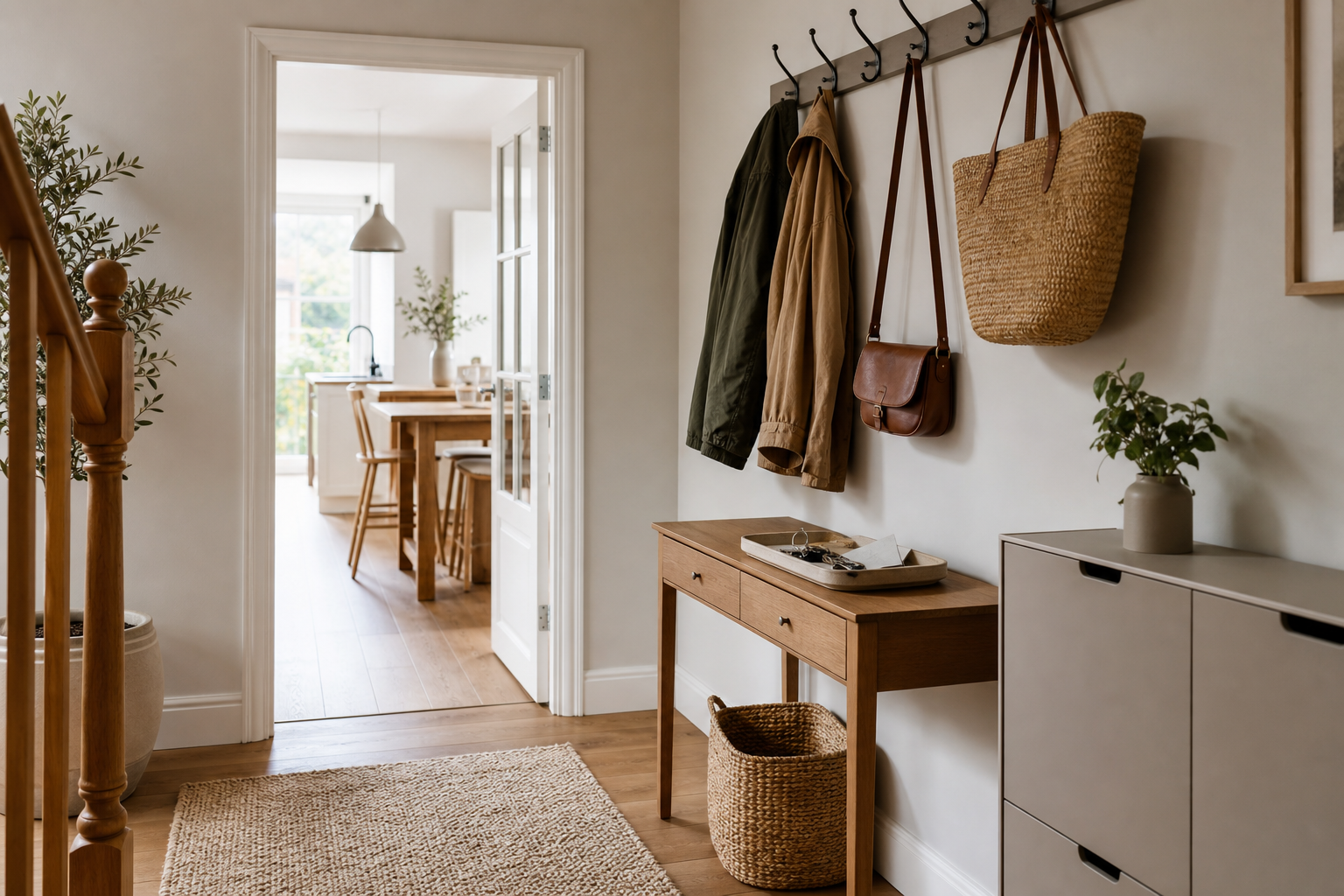
Open hooks are usually more practical for everyday coats than a closed cupboard, particularly in a busy household. They make it obvious where each item goes and avoid the extra step of opening a door. Use sturdy hooks fixed securely to the wall, with enough space between them for coats to hang without becoming one tangled mass.
Keep the number of coats in the main hallway to a manageable amount. Seasonal coats, formalwear and rarely used outer layers can go in a bedroom wardrobe or another storage area. If every hook is permanently full, the hallway will look crowded even when everything is technically in its place.
Bags need their own solution. A hook is suitable for a handbag or a light backpack, while a wide basket or low cupboard may work better for soft bags that do not hold their shape. Avoid putting heavy bags on a high hook if they are difficult to lift safely. For children, place one or two hooks at a reachable height and keep the arrangement simple enough for them to use without help.
If several people use the space, assigning a hook or small section to each person can prevent coats being piled together. It does not need labels or elaborate rules; a consistent position is often enough.
Control shoes at floor level
Shoes are usually the main source of hallway clutter because they arrive in pairs but are rarely removed in an orderly way. Start by deciding how many pairs can reasonably stay by the door. Store only the shoes used regularly in this season, and move the rest to a bedroom wardrobe, under-bed box or other suitable location.
A shallow shoe rack works well where there is enough floor space, while a bench with shelves can combine seating and storage. In a narrow hallway, a slim cabinet may keep shoes contained without reducing the walkway as much as an open rack. Measure the available depth before choosing anything, and leave a clear route through the space.
Keep shoes in pairs and place them with the toes facing out or in the same direction. This small detail makes the storage easier to use and helps reveal when the rack is becoming overfilled. A washable mat can catch some outdoor dirt, but it should not become a permanent storage area for muddy footwear. Let wet shoes dry before putting them into a closed unit, following the care instructions for the material.
Slippers can have a separate basket or shelf if they are used by everyone. Keeping them together avoids the common habit of leaving one pair beside the sofa, one by the stairs and another near the front door.
Create a small station for keys and post
Keys and post need a deliberate landing place because they are easy to lose and arrive frequently. Choose one surface or wall area near the entrance for them, rather than spreading small items across several pieces of furniture.
A small tray can hold everyday keys, while a hook rail keeps them visible and stops them being buried under receipts. Spare keys should not be left in the open hallway; store them somewhere secure and accessible to the people who need them.
For post, use one vertical file, letter holder or shallow tray. The important part is to keep it as an in-tray rather than a long-term storage system. Set a regular point in the week to open, act on or recycle its contents. Remove packaging and junk mail as soon as it comes through the door where possible. If paperwork requires action, move it to the place where bills and important documents are dealt with, rather than allowing the hallway to become an office.
Keep small items such as sunglasses, dog leads or reusable shopping bags in a single drawer or basket if they are genuinely used when leaving the house. A container with a clear limit is more useful than a large box that can absorb unlimited clutter.
Make the layout suit the size of the hallway
In a narrow hallway, use the walls and the backs of doors rather than adding bulky furniture. A row of hooks, a shallow shelf and a slim shoe cabinet may provide enough capacity without making the passage feel cramped. Check that doors, cupboards and radiators can still be used comfortably.
Where the hallway is wider, a console table can provide a useful drop zone, but keep its surface mostly clear. One tray and one small container are usually easier to maintain than several decorative bowls and boxes. Choose furniture with drawers or cupboards if loose items quickly make the room look busy.
In a rented home, removable hooks and freestanding storage can help, but check the weight limits and the condition of the wall before using them. Do not hang heavy coats from fittings that are designed only for light accessories. In any home, secure tall furniture according to the manufacturer's instructions, particularly where children may be present.
Lighting also affects how usable the space feels. Make sure the entrance is bright enough to find keys, check pockets and put shoes away without having to search in the dark. A mirror can be useful near the door, but it should not replace storage or become another surface for items to collect.
Set a reset routine that takes minutes
A hallway stays organised when the daily reset is short and predictable. Each evening, return coats to hooks, pair up shoes, remove empty bags and put post into its proper place. This should take a few minutes when the storage matches the household's needs.
Use a small temporary basket for items that belong elsewhere in the home. Empty it as part of an existing routine, such as going upstairs or preparing for bed. The basket is a transport tool, not a permanent holding area, so avoid letting it become another forgotten pile.
Review the hallway at the change of seasons. Move heavy coats and boots into longer-term storage, check whether shoes still fit or are still used, and adjust the number of items left by the door. If clutter returns quickly, treat that as feedback: the storage may be too far away, too small or too difficult to use.
A successful hallway is not completely empty. It is a space where the things needed to leave and return home have obvious places, and where everything else can be moved on quickly. Keep the arrangement simple, limit what stays on display and review it when household habits change.