How to Choose Bedroom Curtains for Better Sleep and Style
The right bedroom curtains can improve darkness, privacy, warmth and the overall feel of the room. Use this practical guide to choose the best fabric, lining, size and hanging position.
Our guides prioritise practical, original advice. Product links may be affiliate links, but they should only appear when they add something useful.
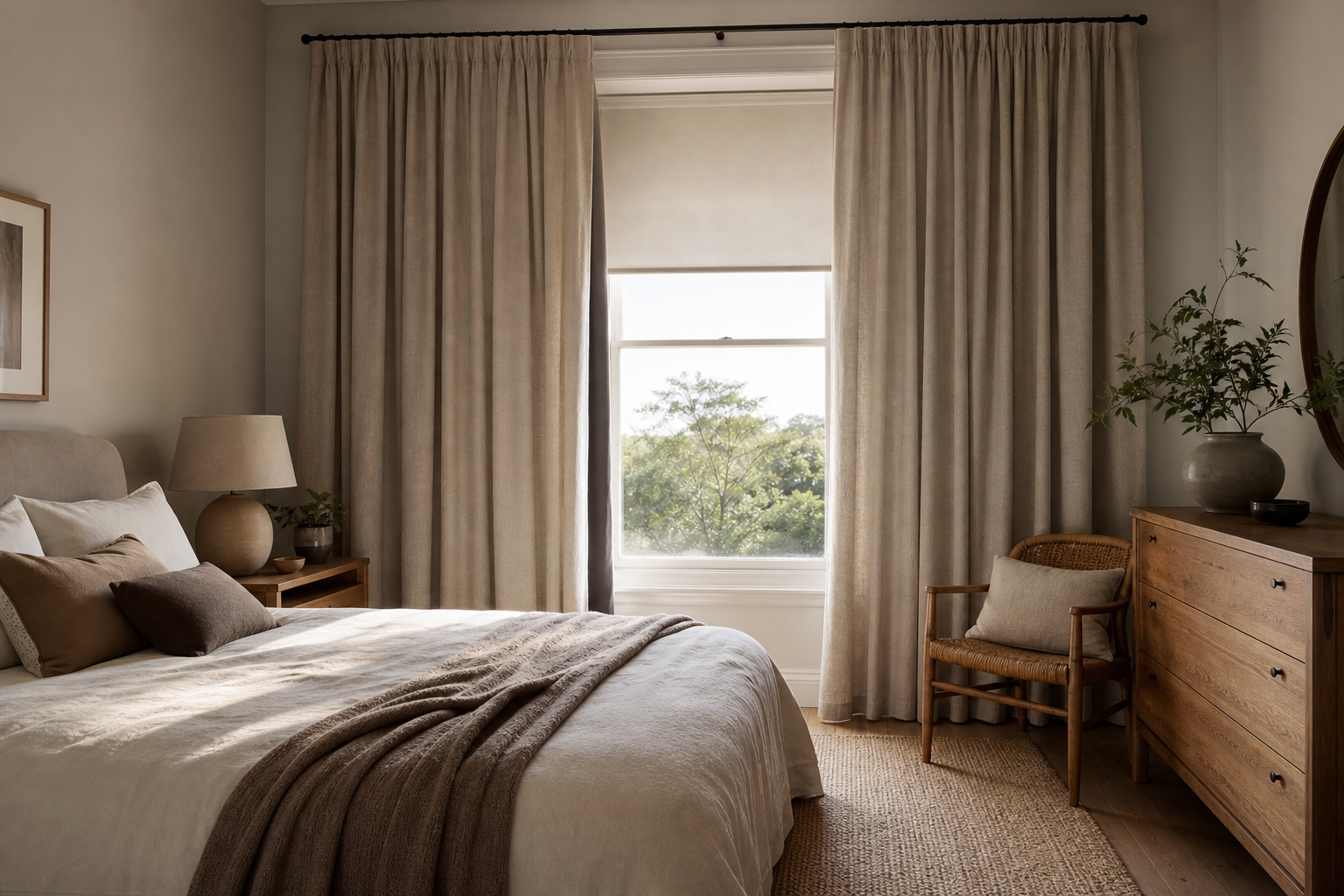
Bedroom curtains do more than soften a window. They can block early morning light, reduce draughts, make a room feel warmer and give the bed area a more finished appearance. The best choice depends on how much darkness you need, the direction your window faces, the size of the room and the look you want to create.
Before choosing a colour or pattern, work out the practical job your curtains need to do. A decorative pair may be enough in a shaded room, while a bright, overlooked bedroom is likely to benefit from a lined or layered treatment.
Decide how much light you need to block
For most bedrooms, a lined curtain is a more useful starting point than an unlined one. The lining adds weight, helps the fabric hang neatly and reduces the amount of light that passes through. It also offers a little extra insulation at the window.
If you are sensitive to early morning light, choose a blackout lining. This is particularly helpful for bedrooms with east-facing windows, street lighting outside or long summer evenings. Blackout curtains do not always create complete darkness: light can still enter around the sides and above the rail if the window treatment is too narrow or hung close to the frame.
In a darker room, standard cotton or polyester lining may provide enough privacy without making the curtains feel heavy. Thermal lining can be useful in a cold bedroom, but check the finished fabric carefully, as thicker curtains may stack further to either side of the window when open.
Choose the right curtain fabric
The fabric affects the way curtains fall, the amount of light they filter and how formal the room feels. Cotton and cotton blends give a relaxed, versatile finish and are available in a wide range of colours. Linen and linen-look fabrics suit bedrooms with a softer, natural feel, although genuine linen can crease and may allow more light through unless it is well lined.
Velvet creates a substantial, cocooning look and works well in a large bedroom or around a tall window. It is also effective at reducing light and draughts, but its weight means the track or pole must be securely fixed. Lightweight polyester blends are practical, often easier to care for and less likely to crease, making them suitable for everyday use.
When comparing samples, hold them up to the window during the day rather than judging them only under shop lighting. Backlighting can make a colour appear paler or more intense. Look at the fabric from both sides too, particularly if the curtains will be visible from outside.
Measure for a fuller, better-fitting look
Accurate measurements make a bigger difference than choosing an expensive fabric. Measure the width of the pole or track rather than relying only on the window width. For a fuller appearance, the total curtain width should usually be around one and a half to two times the width being covered. The exact amount depends on the fabric: heavier materials need less fullness, while lightweight curtains benefit from more.
Measure the drop from the point where the curtain will hang to the place where you want it to finish. Floor-length curtains usually look most considered when they finish just above the floor, with a small gap to prevent dragging. If you prefer a more relaxed, generous look, the fabric can lightly touch the floor, but avoid a deep pool in a bedroom where dust and cleaning are concerns.
Measure in at least three places because floors and ceilings are not always perfectly level. Use the smallest drop if the curtains need to clear the floor neatly. If you are buying ready-made curtains, check the finished measurements rather than assuming the stated size refers to each individual curtain.
Hang curtains higher and wider than the window
Fixing the pole or track close to the window frame can make the window look smaller and may leave gaps where light enters. Where the wall allows, position the fitting several centimetres above the top of the frame and extend it beyond both sides. This draws the eye upwards and allows the curtains to sit clear of the glass when open.
There are practical limits. Avoid placing a pole so high that the curtains become difficult to open, and check for sockets, picture rails, coving and window handles before drilling. If the window is close to the ceiling, a ceiling-fixed track may give a cleaner result than a pole.
Choose the fitting according to the curtain's weight. A substantial pair of lined or velvet curtains needs strong brackets and suitable wall fixings, particularly when the span is wide. A track is often the neatest option for a narrow recess or for curtains that need to open and close smoothly every day.
Use layers for flexibility and privacy
A single curtain treatment may not provide the right balance of privacy, darkness and daytime softness. Layering gives you more control. Curtains paired with a blind can be opened in different combinations depending on the time of day, weather and amount of light required.
A simple roller blind provides a tidy base layer and can deal with privacy without requiring the curtains to be closed. Roman blinds create a softer, more tailored appearance, while a translucent blind allows daylight in but reduces the view from outside. For a bedroom overlooked at close range, choose a blind that offers privacy throughout the day rather than relying on curtains alone.
If the window has a radiator below it, avoid allowing heavy curtains to cover it when they are closed for long periods. A blind or shorter curtain can help heat circulate more effectively. Always follow safety guidance when using cords or chains, especially in rooms used by children.
Select a colour that supports the room
Bedroom curtains do not need to match the walls exactly. A close tonal colour can make the room feel calm and cohesive, while a deeper shade adds contrast around the window. If the walls, carpet and bedding are already patterned, plain curtains will usually be easier to live with. In a simple room, a subtle stripe, check or small-scale pattern can add interest without dominating the space.
Consider how the curtains will look when drawn as well as when they are open. A dark fabric can make a bright room feel more settled at night, but it may also become the strongest feature in a small space. Pale curtains reflect more light during the day and can make the window feel less visually heavy, although they show marks more readily.
Order or borrow a fabric sample where possible and view it beside the bedding, wall colour and flooring. Check it in daylight and lamplight before committing, as bedroom lighting can change the appearance of warm neutrals and muted colours.
Finish the window treatment neatly
Small details determine whether curtains look deliberate or improvised. Make sure the hem hangs evenly, the fabric is not caught behind the radiator and the leading edges meet without a large gap. If the curtains are new and folded from packaging, allow them to hang before steaming or pressing them so the creases can relax.
Keep the area around the window easy to clean. Curtains should not block access to handles, vents or opening sections of the window. Wash or vacuum them according to the care label, and dust the pole or track when cleaning the rest of the room.
The most successful bedroom curtains combine a suitable lining, generous but accurate measurements and a fitting that extends beyond the glass. Once those practical decisions are right, colour and texture can be chosen to complement the rest of the room rather than compensate for a poor fit.